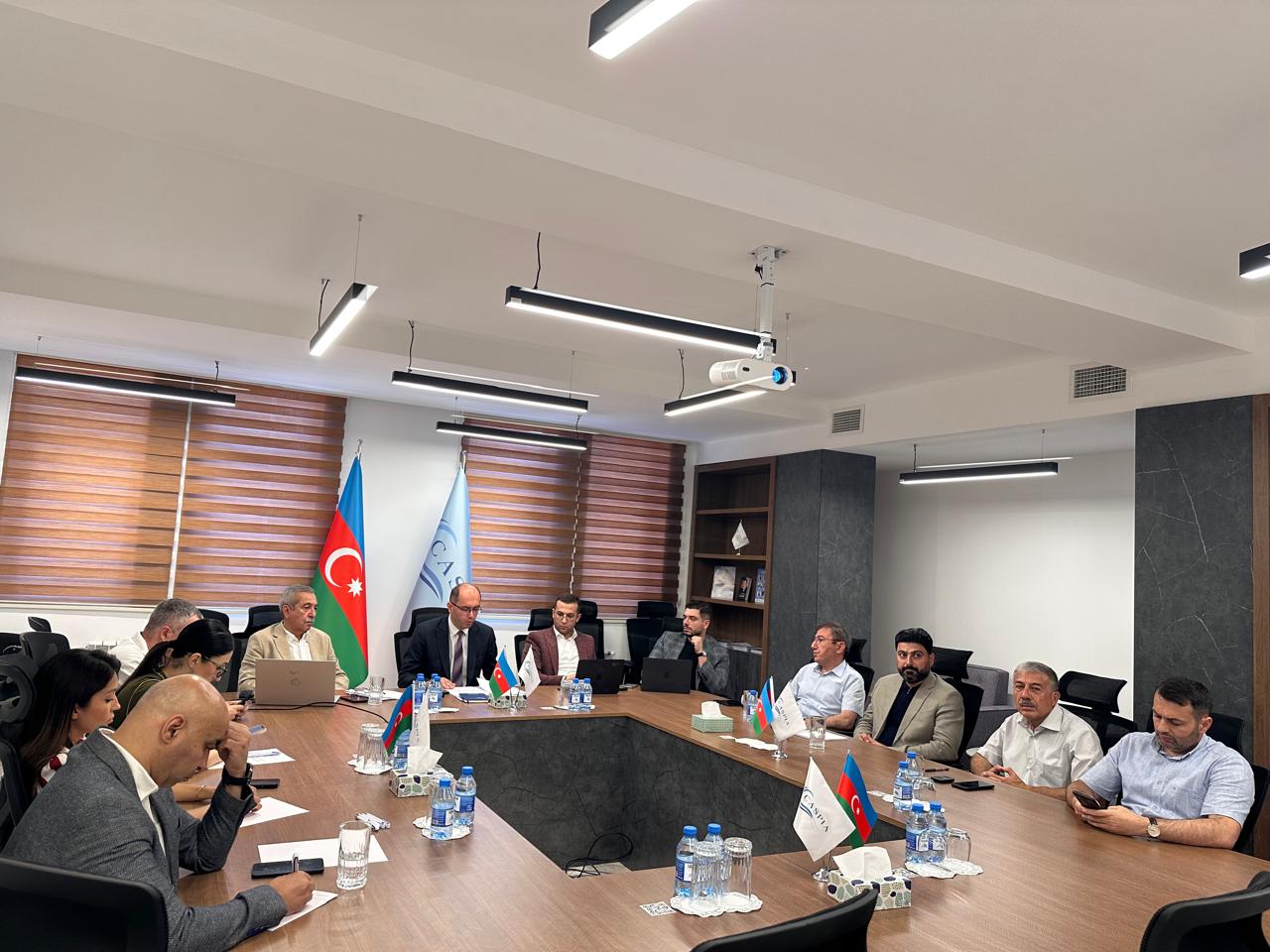
The CASPIA Analytical Center convened a closed-door expert roundtable dedicated to assessing the outcome of Armenia’s parliamentary elections and their broader implications for the evolving geopolitical and security architecture of the South Caucasus. The event brought together distinguished scholars, policy analysts, and media representatives to engage in an in-depth exchange of views on the political ramifications of the electoral process and its prospective impact on regional stability.
The discussions encompassed a broad spectrum of issues, including the political assessment of the election results, Armenia’s post-electoral domestic trajectory, the implications of the emerging political configuration for the regional security environment, the future prospects and challenges of the Azerbaijan–Armenia peace process, the influence of regional and extra-regional actors on Armenia’s foreign policy orientation, the prospective implementation of the T.R.I.P.P. initiative, and Armenia’s potential participation in regional transport and economic integration frameworks.
Opening the event, Orkhan Yolchuyev, Director of the CASPIA Analytical Center, underscored that the parliamentary elections represented a pivotal political development not only for Armenia but also for the broader South Caucasus.
“The elections constitute a watershed moment whose consequences extend well beyond Armenia’s domestic political arena. It is now imperative to closely monitor the evolution of the country’s internal political dynamics, as they will inevitably shape both the regional security environment and the trajectory of the Azerbaijan–Armenia normalization process,” he remarked.
The keynote presentation was delivered by Namiq Aliyev, Professor of Law at the Academy of Public Administration under the President of the Republic of Azerbaijan and Ambassador Extraordinary and Plenipotentiary of the Republic of Azerbaijan.
Professor Aliyev examined the constitutional and legal dimensions of Armenia’s parliamentary elections, placing particular emphasis on issues of constitutional legitimacy and legal consistency. He argued that a constitutional referendum aimed at revising provisions of Armenia’s Constitution—specifically the preamble containing territorial claims against Azerbaijan—remains an indispensable prerequisite for the conclusion of a comprehensive and sustainable peace agreement between the two countries.
Within the framework of the “Bridge of Peace” initiative, Rauf Agamirzayev, transport expert and member of the Public Council under Azerbaijan’s Ministry of Digital Development and Transport, presented an overview of the T.R.I.P.P. project. He emphasized its transformative potential in fostering regional connectivity, facilitating multimodal transport integration, and reinforcing long-term economic interdependence across the South Caucasus.
Political researcher Chingiz Mammadov argued that the normalization process between Azerbaijan and Armenia should continue with determination and be underpinned by a coherent political and legal rationale. In his assessment, a durable peace settlement requires not only sustained diplomatic engagement but also the systematic elimination of the legal and political impediments that continue to hinder reconciliation.
Political analyst and Doctor of Economic Sciences Ilgar Velizade stressed that strategic consistency and long-term stability should remain the guiding principles of the peacebuilding process. Drawing upon comparative international experience, he argued that successful conflict transformation requires careful adaptation of internationally recognized peacebuilding practices to the unique political and historical realities of the South Caucasus.
Additional remarks were delivered by Fuad Abdullayev, Leading Advisor at the Center of Analysis of International Relations (AIR Center) and an expert on political developments and regional security. He emphasized the necessity of harmonizing Armenia’s domestic legal framework to eliminate normative inconsistencies and ensure that national legislation does not undermine or contradict the objectives of the bilateral peace process. According to Abdullayev, legal coherence constitutes a fundamental prerequisite for achieving a sustainable normalization agenda.
Political analyst Zaur Ibrahimli highlighted the increasingly important role of civil society diplomacy in supporting interstate reconciliation. He underscored that, alongside official diplomatic engagement, greater interaction between Azerbaijani and Armenian non-governmental organizations, academic institutions, and expert communities could serve as an effective confidence-building mechanism, facilitating societal dialogue and reinforcing the foundations of a durable peace.
The formal presentations were followed by an extensive expert discussion during which participants exchanged assessments of Armenia’s post-election political trajectory, the evolving regional security environment, prospects for advancing regional connectivity initiatives, and the future of the Azerbaijan–Armenia normalization process. Particular attention was devoted to the growing significance of Track II diplomacy and expert dialogue as complementary instruments for promoting regional stability and fostering long-term cooperation.
The roundtable forms part of the CASPIA Analytical Center’s ongoing commitment to generating evidence-based policy analysis and facilitating high-level expert dialogue on issues of regional security, international affairs, and geopolitical transformation across the South Caucasus and the wider Eurasian region.