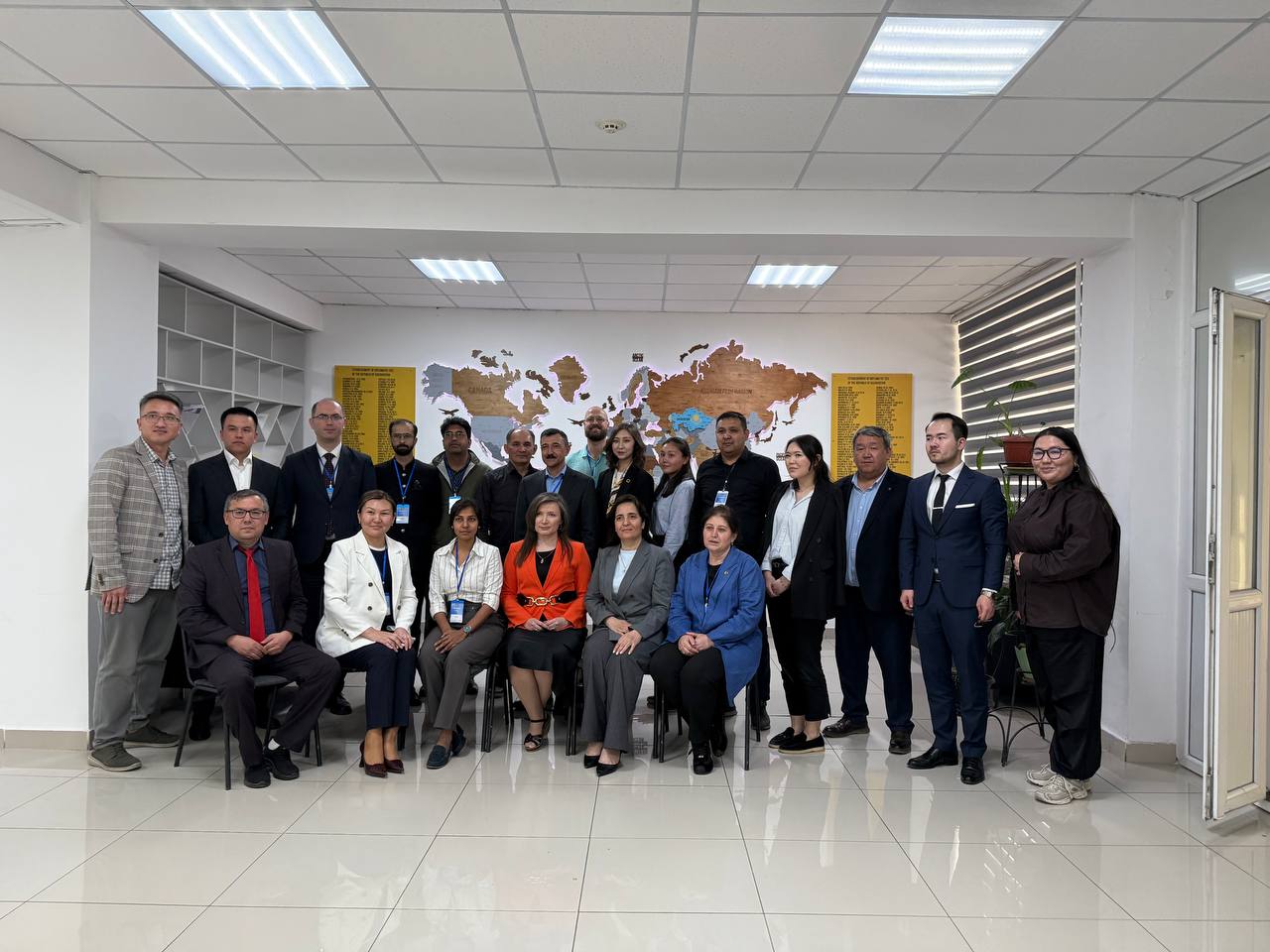
The CASPIA Analytical Center participated in an international scientific and practical conference held at Al-Farabi Kazakh National University in Almaty under the theme “Security, Geopolitics, and Turkic Integration in the Central Asia – South Caucasus – Middle East Triangle.” The conference brought together scholars, experts, analysts, and representatives of the academic community to discuss issues related to international and regional security, contemporary geopolitical transformations, and the prospects for Turkic integration in a context of global instability.
The program included four thematic sessions addressing key topics such as geopolitical shifts across Central Asia, the South Caucasus, and the Middle East; challenges related to conflicts and terrorism; strategic stability; the development of Turkic integration; as well as international transport corridors, logistics, and geoeconomic dynamics.
CASPIA Director Orkhan Yolchuyev delivered a presentation focusing on the evolving role of the Organization of Turkic States (OTS) in the current geopolitical environment. He noted that against the backdrop of Russia’s war in Ukraine and the weakening of traditional collective security institutions in the post-Soviet space, the OTS has strengthened coordination in areas such as strategic autonomy, defense cooperation, military education, and the exchange of experience. At the same time, the organization deliberately avoids positioning itself as a military bloc, thereby maintaining flexibility and avoiding direct confrontation with major power centers.
Yolchuyev highlighted that the region in which the OTS operates has traditionally been influenced by Russia and China; however, this balance is gradually shifting. Sanctions pressure and military expenditures have limited Moscow’s ability to sustain its previous level of influence, while China is expanding its economic presence, carefully avoiding overt political or military dominance. Under these conditions, Turkic states increasingly rely on horizontal coordination, with the OTS emerging as a mechanism of collective maneuver—a form of “soft sovereignty” that enables states to strengthen their positions without abandoning a multi-vector foreign policy. Russia, as he described, approaches the organization with cautious pragmatism, perceiving it both as a platform for cooperation and as a potential alternative to integration initiatives led by Moscow. China, in turn, evaluates the OTS primarily through a geoeconomic lens, particularly in relation to transport corridors within the Belt and Road Initiative, while the European Union considers it a potential partner in infrastructure, energy, and sustainability projects.
In conclusion, Yolchuyev noted that the Organization of Turkic States is gradually transforming into a mechanism for regional strategic balance. In the context of an emerging multipolar world, its significance will be determined not so much by its institutional structure as by its ability to coordinate interests, manage transit flows, and act as a mediator between key centers of power in Eurasia.