
The Middle Corridor is one of the key transport routes connecting China and Europe via the Caspian Sea, the South Caucasus, and Central Asia. In the context of a changing global geopolitical and economic environment, this route is gaining increasing importance as an alternative to traditional pathways, enabling the diversification of supply chains and enhancing the resilience of international logistics. However, the development of the Middle Corridor faces a number of serious challenges: from infrastructural constraints and congestion in ports to fragmentation of information systems and organizational barriers.
Given the need for a comprehensive analysis of the current state and prospects of the route, the CASPIA analytical center initiated a survey of leading experts in international logistics, digitalization of transport processes, and regional cooperation. The aim was to identify key problems, exchange experience, and find practical solutions capable of increasing the efficiency and competitiveness of the Middle Corridor on the global stage. The article presents the views of specialists from Germany, China, Turkey, and Georgia, who have a deep understanding of the route’s specifics and are actively involved in its development.
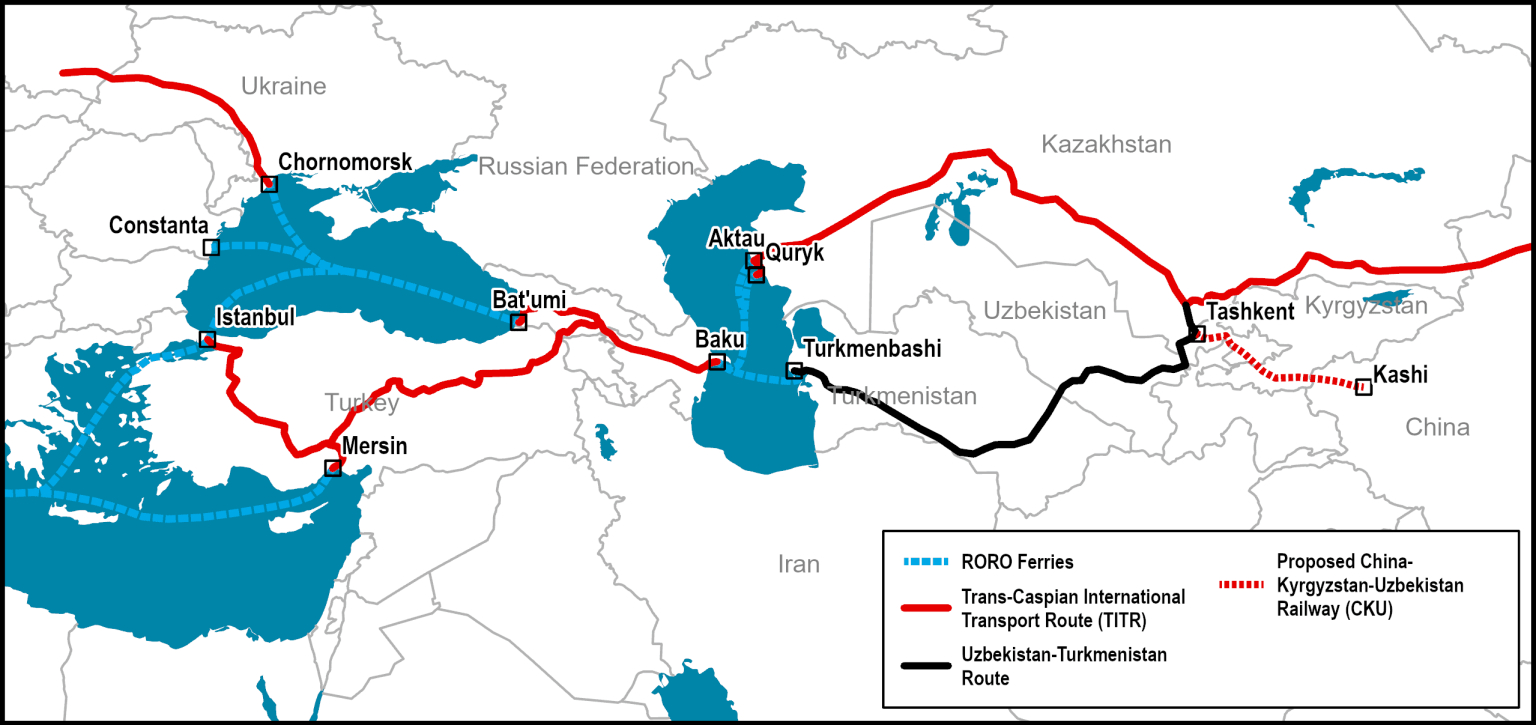
Speaking about the current state of the Middle Corridor, Werner Pieters, a leading expert in international logistics and the digitalization of transport corridors and a representative of the German company NFident GmbH, which specializes in digital solutions for ports and logistics hubs, does not hide his concern. He emphasizes that the infrastructure along the route suffers from a number of bottlenecks, and not all of them are technical in nature. Among the obvious problems he mentions the limited capacity of ferries in the Caspian Sea, the shortage of locomotives and wagons in Azerbaijan and Georgia, as well as outdated port infrastructure. But, according to Pieters, an even deeper and more systemic problem is the non-digitalized, uncoordinated, and fragmented information environment between different transport systems and at border interfaces along the entire Trans-Caspian route (TITR).
“Today the main problem is data visibility. Shippers simply get lost: due to multiple operators and fragmented interfaces, it is practically impossible to predict costs or accurately plan a route,” he explains.
In his view, the fragmentation of information among all participants in the logistics chain creates a whole set of uncertainties: from unstable transit times to congestion, high costs, and basic operational inefficiency. He sees the solution in the consistent digitalization of all processes: from transit and borders to customs control systems and interaction between ports and inland terminals.
“Digital transformation, a clear data flow, and the implementation of compatible digital systems — this is the path to real efficiency and transparency across the entire route,” Pieters believes.
Reflecting on the nature of these limitations, he identifies two levels — technical and organizational-political. According to him, the issue of system interoperability is key. He explains that modern management systems (ERP, WMS, TMS) are in principle supposed to communicate via API and EDI, but in reality everything operates in isolation. Incompatible standards, outdated solutions, and different data structures turn logistics, in his words, into a “Potemkin village.”
But that is not all. Pieters emphasizes that technical problems are compounded by distrust, reluctance to share data, and fragmented governance in the region. Under such conditions, even the most advanced technologies, including AI and predictive analytics, operate ineffectively. “AI is powerful, but it is blind if you feed it dirty and inconsistent data,” the expert notes figuratively. “Without a unified standard, without open trusted exchange, all this digitalization is just a set of local improvements.”
Regarding congestion and incompatibility in logistics, especially in the Caspian region, Pieters considers the situation critical. Differences in technologies, incompatible processes, port congestion, and infrastructure gaps all combine into a formula of systemic delays and risks.
“Every time cargo is transferred from one operator to another, from one country to another, potential disruptions arise. Differences in standards, mismatched systems, lack of transparency — all this does not just slow things down, it makes the entire model vulnerable,” he says.
For the ports of Baku, Aktau, and Turkmenbashi, he proposes concrete solutions: investments within public-private partnerships, installation of intelligent cameras and gates, creation of digital platforms for cargo flow management, improved connectivity with inland regions, and formalization of route management.
“If we want the Middle Corridor to be competitive, we urgently need coordination. We must work as a single organism, not as a set of isolated nodes,” Pieters believes.
Speaking about logistics hubs along the route, he notes that the efficiency of the entire chain depends on how smoothly internal networks function — roads, railways, warehouses. In practice, however, internal disruptions create congestion at ports, where cargo accumulates without the ability to move quickly onward. He explains: “We have a shortage of personnel, no drivers, not enough operators or warehouse workers. Add infrastructural constraints to this — and you get constantly congested, inefficient ports.”
Pieters also emphasizes the importance of using KPIs — performance indicators: delivery timeliness, order accuracy, terminal capacity utilization, truck waiting times, and other metrics that allow logistics hubs not only to evaluate themselves but also to quickly identify and eliminate weak points.
Regarding customs and transit procedures, Pieters calls their reform one of the fastest and most effective steps to relieve pressure on the corridor. He cites the TIR system as an example, which allows goods to move under customs control with deferred duty payments and simplified procedures.
“But it is important not just to implement TIR or other international tools. We need to create a unified technological space — with pre-approval of transports, electronic seals, digital declarations, and full mutual trust between countries,” he emphasizes. Among such solutions is the NEXUS Hinterland Community System, which enables closer cooperation between ports and terminals, moving toward the concept of a “virtual long quay.”
Comparing the Middle Corridor with the Northern and Southern routes, Pieters states directly that investments are needed — both in “hard” infrastructure and in “soft” digitalization and management. Here, in his view, European companies and organizations can play a major role.
At the end of the interview, Pieters identifies three priority steps for the next five years. First, creating conditions for the growth of the private sector in Central Asia and the South Caucasus. Second, developing regional logistics services capable of supporting both trade and transit. Third, promoting common standards and approaches to the sustainable development of the route.
“We must create the attractiveness of the corridor. Today it is reduced by excessive bureaucracy, uncoordinated permits, and lack of cooperation at borders. Only large-scale investments in ports, digitalization, and multimodal solutions can bring the Middle Corridor to real global competitiveness,” he says.
John Brakefeldt, a Georgian logistics expert and President of the European Business Association (EBA) in Georgia, shared his view on the prospects of developing the Middle Corridor. According to him, the Middle Corridor is becoming increasingly visible in the context of changing geopolitical conditions. It has not accidentally been called an “alternative bridge” between China and Europe — and this metaphor, according to the expert, is quite accurate. In a situation where traditional routes face new challenges, the need for more flexible, diversified, and resilient supply chains is growing. In this context, the Middle Corridor appears as a real alternative that could significantly strengthen its position over the next 10–15 years.
As Brakefeldt emphasizes, the success of the route will depend on two key factors: coordinated cooperation between the countries involved in the project and consistent development of logistics infrastructure. “If we continue to develop cooperation and invest in infrastructure — not only physical but also digital — this route will become not just an alternative, but a strategic link in global trade,” he believes.
However, enthusiasm does not eliminate reality. The expert reminds that the Middle Corridor is full of complexities. It passes through several countries, regulatory regimes, and different modes of transport, all of which create multiple potential bottlenecks. Particularly vulnerable points, he says, remain transition zones — such as Caspian ports, railway transshipment stations, and border crossings. “These sections are the most sensitive to disruptions, whether physical congestion or bureaucratic barriers. We cannot ignore the fact that in some places capacity still does not match growing demand,” Brakefeldt notes.
He emphasizes that coordination between customs services and transport operators plays a crucial role. Another decisive factor, he says, will be digital integration along the entire route: “Without digitalization — nowhere. Electronic documents, unified platforms, process transparency — all this not only speeds up cargo movement but also reduces risks and costs.”
Commenting on investment plans of participating countries, Brakefeldt is cautiously optimistic. He says the volume of announced projects is impressive and demonstrates seriousness of intent, but the key question is priorities. “The most important thing now is to direct investments where they will have the greatest short- and long-term impact. This includes projects improving multimodal connectivity, expanding ports, and modernizing railway infrastructure,” he explains.
At the same time, he draws special attention to the need to develop so-called “soft infrastructure” — digitalization, standardization of rules, and reduction of paperwork. In his view, these steps will help “unfreeze” the most problematic areas and ensure smooth operation of the corridor.
Speaking about political risks, Brakefeldt does not hide that they exist. The Middle Corridor passes through countries with varying degrees of political stability, and this cannot be ignored. However, he stresses that everything depends on creating sustainable mechanisms of cooperation. “We need to think years ahead. It is necessary to build frameworks that will function regardless of changes in political conditions. These can be interstate agreements, institutional platforms for continuous dialogue, and partnerships with the private sector,” he says.
Brakefeldt is also convinced that the business community must play a key role at all stages — not just as a consumer of logistics services, but as an active participant in shaping the route. “The private sector is capable of identifying inefficiencies and risks that are not always visible from the perspective of government structures. Therefore, dialogue with business is not an option, but a necessity,” he emphasizes.
As for the next 2–3 years, Brakefeldt calls this period “decisive.” According to him, it is now that the foundation for a competitive route must be laid. Priorities include improving coordination between transport systems of different countries, developing digital platforms and electronic documents, and launching pilot projects that could demonstrate the reliability and efficiency of the route in practice. “We need to show that this route works. Not on paper — in reality. Only then will shippers, logistics operators, and investors believe in it,” he says.
Turkish logistics and transport expert, representative of Middle Corridor Logistics, Hilal Agun, shared her detailed vision of current logistical barriers and opportunities that could significantly improve the route’s performance.
Speaking about the most pressing problems hindering the development of the Middle Corridor, Hilal Agun noted that the key bottlenecks today are limited port and railway capacity, as well as an insufficient number of ferries. In addition, lengthy procedures at some border crossings remain a problem. All of this significantly slows down cargo movement. Alongside this, there is another systemic difficulty — inconsistencies in regulation and infrastructure between countries along the route, which directly and negatively affect overall efficiency.
A special place in the logistics structure of the route is occupied by the Caspian Sea, which, as the expert notes, is indeed one of the most complex segments. Here, problems often arise due to weather conditions, a limited number of available ferries, and insufficient port capacity. However, according to Hilal Agun, it would be incorrect to reduce all problems solely to the Caspian Sea. Similar difficulties are observed in other parts of the route as well.
In particular, delays are recorded in road and rail connections. Some railway segments are already operating at maximum capacity, creating serious logistical obstacles. In addition, problems arise at border crossings where infrastructure often does not meet modern requirements. It is important to note that this is not only about infrastructure shortcomings but also a deeper problem: the lack of proper coordination and differences in operational procedures between countries. These differences complicate coordination, extend transit times, and reduce predictability.
As for possible solutions, Hilal Agun believes priority should be given to expanding port and railway infrastructure. Without this, significant increases in cargo volumes are impossible. The next necessary step, she emphasizes, is the introduction of digital tracking systems that ensure transparency and real-time cargo monitoring. This would reduce errors, simplify control, and increase trust among shippers.
Equally important, she says, is the development of cross-border coordination mechanisms. Today, the lack of harmonized procedures between countries significantly slows down the movement of goods. Institutional reforms and standardization of processes, in her view, will reduce border crossing times, eliminate duplicate administrative actions, and ultimately improve predictability of transport logistics.
Among the most urgent infrastructure priorities, Hilal Agun highlights increasing ferry capacity in the Caspian Sea. This is a critical element directly affecting the stability of the entire route. She also believes that critical railway segments operating at full capacity must be strengthened. Another key area is modernization of border crossing infrastructure, including both physical facilities and organizational processes.
In discussing long-term strategies to attract additional cargo flows, the expert emphasizes that digitalization and reforms will play a decisive role. Modern technologies such as digital tracking systems, blockchain solutions in logistics, and the use of artificial intelligence for planning can significantly increase operational efficiency. In her view, these tools will minimize human error, reduce risks, and ensure more accurate delivery forecasting.
At the same time, she believes that marketing and international awareness also play an important role. Without active information efforts aimed at strengthening the image of the Middle Corridor as a reliable and high-tech route, it is difficult to expect an increase in cargo flows. Therefore, it is necessary not only to implement innovations but also to communicate them to the global community.
Innovative technologies, according to Hilal Agun, can not only improve transparency and predictability of transportation but also significantly reduce delays. It is precisely through a combination of digital solutions, institutional reforms, effective coordination, and international marketing that a modern, sustainable, and competitive logistics platform can be created — which is what the Middle Corridor should become.
Wangxu Dong, a Chinese transport and logistics expert and Managing Director of Beijing Trans Eurasia International Logistics Co. Ltd., shared his perspective on the current situation and prospects of the Middle Corridor. In his view, despite positive developments, the route still faces serious challenges that require coordinated action from all participants in the transport chain.
He notes that beyond the Caspian segment, hardware-level problems remain, including limited land capacity on the Baku–Poti section, unreliable shipping schedules from the ports of Poti and Batumi (Georgia) to European ports, and bottlenecks at the Georgia–Turkey border on the inbound route to Turkey. All of this, according to Wangxu Dong, creates disruptions and uncertainty in the logistics chain, reducing the attractiveness of the route for clients.
But it is not only “hardware” that requires attention. As the expert emphasizes, at the software level it is necessary to achieve smoother transitions in transport and transit procedures, as well as in document exchange across all segments of the route. He believes digitalization should ensure seamless interaction at these interfaces, and here lies one of the main levers for improving the efficiency of the Middle Corridor.
He expresses his view confidently: “If the Middle Corridor is to remain a long-term choice for clients, coordinated efforts from all participants in the chain will be required. This cannot be the task of a single company or a single state — only united action will bring sustainable results.”
As one practical solution, Wangxu Dong proposes utilizing the existing four-party railway joint venture CRCT, KTZE, ADY, and the Georgian Railway. He explains that this JV could organize regular ferry services across the Caspian Sea with year-round frequency — both in peak and off-peak seasons — which is critical for stability and predictability of logistics processes.
He suggests that Chinese clients could guarantee a certain base cargo volume and shipment frequency, thereby ensuring the stability of the route. This same enterprise, he says, should take responsibility for coordinating the fast transfer of cargo between all links in the transport chain and rapidly implementing a unified digital platform, while simultaneously increasing capacity and continuously modernizing infrastructure along the entire route.
Wangxu Dong states firmly: “Digitalization is no longer a problem. In my view, it is the fastest and simplest way to improve the efficiency of the Middle Corridor. It allows us to plan volumes in advance, prepare assets, coordinate transfers at every stage — and all of this together radically improves the overall efficiency of the transport chain.”
Reflecting on the role of Chinese companies in the development of the corridor, he emphasizes that Chinese enterprises act both as cargo organizers and as builders of the corridor in the process of expanding transport and trade links with Europe and the South Caucasus. He proudly notes that his company, Beijing Trans Eurasia International Logistics Co., Ltd., has been actively organizing cargo transportation since 2022, cooperating with partners to improve operational efficiency, and conducting shipping in the Black Sea, connecting Burgas (Bulgaria) with ports in Southern Italy in order to improve the customer experience on the European direction.
The expert cites the development of the Xi’an logistics hub in Alat and the Lianyungang Port Group investment project in Aktau as examples. These projects, he emphasizes, benefit not only Chinese companies but all participants along the entire length of the corridor, while also attracting new investors and strengthening trust and interest in the route.
In conclusion, Wangxu Dong stresses the need for a systemic approach: “If we want the Middle Corridor to become a sustainable, attractive, and competitive route in the long term, we must work as a unified team. With a common goal, a common digital platform, and shared responsibility. Chinese companies are not just users of this route. We are building it — step by step, investing in infrastructure, creating services, and paving the way for other participants. And we will continue to do so.”
Speaking about the role of the Middle Corridor in global logistics, Liliana Krutonog, a recognized expert in transport and logistics and CEO of the international logistics company MALBI-trans, emphasizes that over the next 10–15 years this route has the potential to become a stable and strategically important channel between Europe and China. Against the backdrop of changing geopolitics, she says, the importance of the route may grow many times over. She stresses: “If we consider an optimistic scenario — provided that we see active coordination between government structures and private investors, investments in ports and fleet, digitalization, and transit guarantees — the route can occupy a stable niche as an ‘alternative bridge’ for part of the container flow between China and the EU.”
According to her, such prospects are also confirmed by international assessments: the World Bank predicts a tripling of volumes with targeted investments, and the President of Kazakhstan has spoken about the possibility of increasing cargo flows fivefold. However, in order for these figures to become reality, a number of systemic constraints must be addressed.
One of the main challenges today, she says, is bottlenecks that hinder stable and fast cargo delivery. First of all, this concerns the maritime transshipment segment via the Caspian Sea — ports and fleet. Liliana explains that the ports of Aktau and Kuryk (Kazakhstan), as well as Alat (Azerbaijan), are currently unable to cope with growing demand: “They are bottlenecks in terms of berth depth, terminal modernization, and transshipment density.”
She also notes the insufficient number of modern Ro-Ro and container vessels, while port handling capacities are limited, causing delays and downtime. In addition, the problem is exacerbated by natural factors: the level of the Caspian Sea continues to decline, leading to underloading of vessels and the need for constant dredging.
The next vulnerable section is the Baku–Tbilisi–Kars (BTK) line, especially in the South Caucasus. Despite ongoing modernization, including electrification, the line still has single-track sections, a shortage of locomotives and wagons, and lengthy procedures at border stations.
Krutonog also draws attention to bureaucratic and documentary bottlenecks. According to her, differences in tariff policies, lack of a unified electronic window, and uneven compliance with deadlines lead to accumulated delays and unpredictability of delivery times.
She notes that the limited fleet base in the Caspian is particularly concerning. Due to the shortage of appropriately sized vessels for container and Ro-Ro transport, the maritime segment of the route remains dependent on a small number of operators and their schedules. This negatively affects transit reliability and increases logistical risks.
Discussing projects that could “unfreeze” bottlenecks, Liliana emphasizes the critical importance of developing and deepening the ports of Aktau and Kuryk, as well as bringing the port of Alat to full capacity. She explains that this includes expanding container terminals, installing new cranes, deepening waterways, and creating efficient Ro-Ro lines. This, she says, would reduce intermodal delays and enable the launch of through block trains.
She also highlights the need to increase the feeder fleet: “The rapid purchase or leasing of several modern container or Ro-Ro vessels will have an immediate effect, because the maritime segment will no longer depend on the schedules of single operators.” She adds that countries such as Kazakhstan and Uzbekistan have already begun implementing such programs and purchasing vessels.
A separate emphasis is placed on modernization of the BTK line, including installation of modern signaling systems, construction of second tracks, and upgrading locomotives and wagons. According to Krutonog, such investments could produce tangible results within 1–3 years after equipment delivery and modernization of key nodes.
But the problem of the Middle Corridor is not only infrastructure, the expert notes. Significant risks lie in political instability and internal vulnerabilities of participating countries. In her view, the solution must be systemic and multilateral: legally binding transit guarantee agreements are needed, specifying clear timelines, tariffs, and responsibilities of the parties.
She also insists on creating a corridor operator or managing organization with real authority and resources. Such a body would coordinate schedules, allocate capacity, manage emergencies, and increase trust among shippers.
In addition, diversification of routes and ports is necessary to reduce dependence on local conflicts or accidents and increase the overall resilience of the corridor.
Krutonog outlines specific steps that must be taken over the next two to three years to turn the Middle Corridor into a fully competitive route. First, it is necessary to urgently lease or charter 6 to 12 container and Ro-Ro vessels for the Caspian Sea. This would have an immediate effect, reduce queues, and eliminate uncertainty in the maritime segment. Second, ports must be rapidly modernized and deepened, including installation of dock cranes and temporary mobile transshipment systems. Next, a unified electronic window and digital document standards (such as e-CMR, e-FTI) should be implemented. It is also necessary to temporarily lease locomotives and wagons for the BTK line and organize additional trains to prevent container accumulation at ports. All of this, she believes, should be coordinated by a special working committee including representatives of Kazakhstan, Azerbaijan, Georgia, Turkey, as well as the European Union and China. Such a body could oversee investments and infrastructure program implementation.
In conclusion, Liliana Krutonog emphasizes: “If we want the Middle Corridor to become a fully competitive route, we need to act not tomorrow, but today. The window of opportunity is open — and we cannot afford to miss it.”