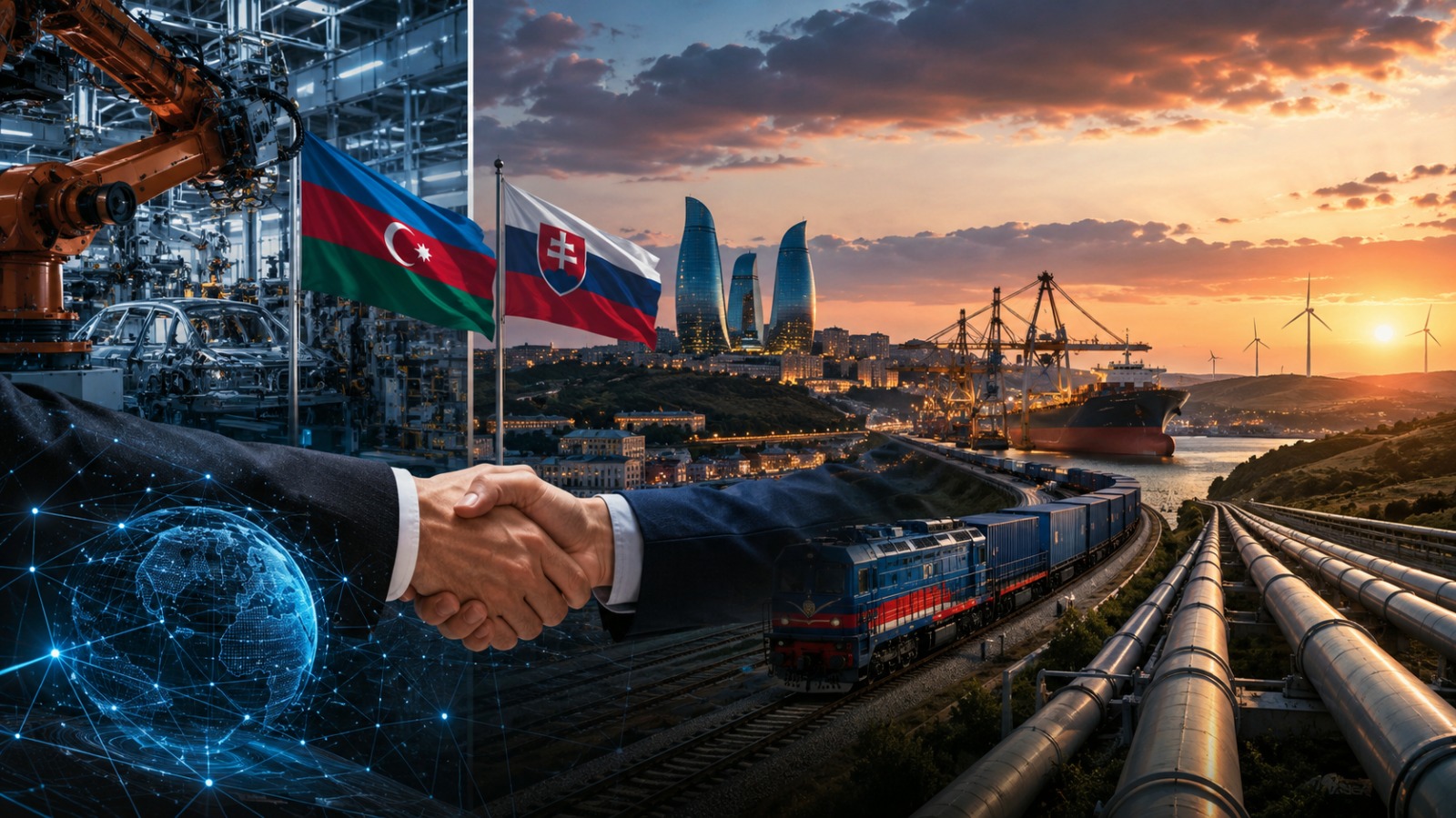
Central Europe as a new priority in Azerbaijan's foreign policy
In recent years, the European dimension of Azerbaijan's foreign policy has undergone a noticeable transformation. While Baku previously focused primarily on engagement with European Union institutions and the leading countries of Western Europe, it is now placing increasing emphasis on strengthening ties with Central European states. Hungary, Romania, Bulgaria, the Czech Republic, and now Slovakia are gradually emerging as distinct priorities within Azerbaijan's diplomatic agenda.
This shift comes at a time when Europe is simultaneously reshaping its energy architecture, seeking alternative transport corridors, and accelerating industrial modernization. Against this backdrop, the strategic interests of Azerbaijan and the countries of Central Europe have become far more closely aligned than they were a decade ago. The official visit of Slovak President Peter Pellegrini to Azerbaijan serves as another illustration of this trend, although its significance extends well beyond the bilateral relationship.
The recent intensification of relations reflects not only changes in Europe's geopolitical landscape but also the arrival of a more pragmatic political leadership in Slovakia. During the presidency of Zuzana Čaputová, cooperation between the two countries largely evolved within the broader framework of the European agenda. Under President Peter Pellegrini, however, greater emphasis has been placed on economic cooperation, industrial development, and investment. At the same time, it would be misleading to attribute the current rapprochement solely to domestic political changes in Slovakia. Rather, it forms part of a broader transformation of Europe's energy and economic policies.
Equally important is the fact that the current visit does not represent the beginning of bilateral engagement. Peter Pellegrini first visited Azerbaijan in 2018 as Prime Minister of Slovakia and returned again in 2024 to participate in COP29. Likewise, President Ilham Aliyev paid his first official visit to Slovakia only at the end of 2025, despite the fact that diplomatic relations between the two countries have existed for more than three decades. In many respects, the period between 2024 and 2026 marked the beginning of a fundamentally new phase in bilateral relations. The latest visit should therefore be viewed as the continuation of a process that has been developing over several years rather than as a response to isolated political events.
When each high level visit is examined separately, bilateral relations appear to have evolved gradually. A broader assessment of developments over the past two years, however, reveals a more substantial transformation. Within a relatively short period, the two countries have steadily expanded the scope of their cooperation, moving from energy to industrial development, then to security, and more recently to joint participation in the reconstruction of Karabakh. This progression points to the emergence of a long term model of economic partnership rather than a series of isolated initiatives.
Energy is no longer the sole foundation of the partnership
Much of the existing analysis portrays Slovakia's growing interest in Azerbaijan primarily as a response to the need to diversify its natural gas supplies. While this interpretation is valid, it captures only part of the broader picture.
Following the suspension of Russian gas transit through Ukraine on 1 January 2025, Slovakia faced an urgent need to identify alternative energy arrangements. During their meeting in Shusha, President Peter Pellegrini expressed his appreciation for Azerbaijan's readiness to supply natural gas and confirmed that ministers from both countries are already discussing a long term framework for energy cooperation beyond 2027.
A closer examination of the statements made by both sides, however, suggests that energy is no longer the sole focus of the bilateral agenda. Unlike in previous years, the discussions placed considerable emphasis on industrial cooperation, joint investment, transport connectivity, digital technologies, and defense collaboration. This shift indicates that the relationship is gradually evolving beyond the traditional supplier customer model toward a broader framework of industrial partnership.
For Azerbaijan, this transition carries strategic significance. Baku no longer views energy exports as the only foundation of its engagement with Europe. While energy cooperation addresses today's immediate challenges, collaboration in innovation and advanced technologies has the potential to shape bilateral relations for decades to come. In this context, the growing emphasis on digital transformation and artificial intelligence within the bilateral agenda can be seen as evidence that Azerbaijan and Slovakia are moving beyond short term priorities toward the development of a long term technological partnership.
Slovakia's value to Azerbaijan goes beyond trade
From an economic perspective, Slovakia is not yet among Azerbaijan's largest trading partners within the European Union. For this reason, it would be misleading to explain the recent momentum in bilateral relations solely through the growth of trade. For Baku, Slovakia's importance lies elsewhere.
First, Slovakia is one of Central Europe's leading industrial economies. Its automotive industry, mechanical engineering, energy equipment manufacturing, and defense sector form the backbone of the country's industrial base. These are precisely the industries that hold the greatest strategic interest for Azerbaijan as it advances an ambitious program of industrial development across its liberated territories.
Second, Bratislava has adopted a notably pragmatic approach toward its relationship with Azerbaijan. Unlike some European partners, where political considerations often overshadow economic cooperation, the dialogue between Azerbaijan and Slovakia has focused on concrete projects with clear commercial and industrial value. This suggests that Slovakia seeks to build its partnership with Azerbaijan on the basis of long term economic and sectoral interests rather than short term political considerations.
Third, Slovakia remains an important participant in the European Union's energy and transport policies. For Azerbaijan, stronger ties with Bratislava enhance its position not only in bilateral relations but also across Central Europe as a whole. In this sense, Baku's strategy extends beyond engagement with Slovakia as an individual country. It reflects a broader effort to deepen its presence and strengthen its partnerships throughout the Central European region.
Why Shusha has become the centerpiece of high level diplomacy
The choice of Shusha as the venue for the talks was equally significant. Since 2023, visits to Karabakh have become a regular element of the itineraries of most foreign leaders traveling to Azerbaijan. What has changed, however, is the purpose of these visits.
Where foreign delegations were once shown the consequences of conflict, they are now presented with the realities of post conflict reconstruction and economic development. This marks a fundamental shift in Karabakh's diplomatic role. Rather than serving primarily as the focus of international political debate, the region is increasingly being positioned as a destination for investment and long term economic cooperation.
During President Pellegrini's visit, particular attention was given to infrastructure reconstruction, the development of new residential communities, opportunities for foreign companies, and emerging investment projects. In this context, Shusha is gradually becoming one of Azerbaijan's key instruments of economic diplomacy. This reflects a broader evolution in Baku's approach to presenting Karabakh internationally. While the restoration of historical justice once dominated the narrative, the emphasis is now increasingly placed on the region's economic potential and future development opportunities.
It was in this context that President Pellegrini remarked that "the Slovak footprint will remain in Karabakh forever," referring to the expected participation of Slovak companies in reconstruction and development projects across the region.
Defense industry emerges as a new area of cooperation
Another noteworthy aspect of the visit was the prominence given to security and defense cooperation. In their joint statements, the two presidents focused not only on energy but also on expanding collaboration in security and the defense industry, highlighting the increasingly broad scope of bilateral relations.
President Pellegrini confirmed that the first tangible results of cooperation in the defense sector will be presented at the ADEX International Defense Exhibition in Baku this September. He also announced that Slovakia will continue to serve as NATO's Contact Point Embassy in Azerbaijan throughout 2027 and 2028. These developments demonstrate that bilateral cooperation is steadily expanding beyond its traditional energy dimension.
It is also important to recall that the foundations for defense cooperation were laid as early as 2023, when the two countries reached an agreement on collaboration in the defense industry. The issue gained further momentum during President Ilham Aliyev's official visit to Bratislava in December 2025. At that time, President Pellegrini stated that Slovakia was prepared to transfer technologies, localize production in Azerbaijan, and jointly explore opportunities in international defense markets.
What makes this approach particularly significant is that it moves beyond the conventional buyer seller relationship that has traditionally characterized defense cooperation. The statements made by both sides suggest that Azerbaijan is seeking a deeper industrial partnership based on joint production, localized manufacturing, and the exchange of technological expertise.
This approach is fully consistent with Azerbaijan's long term strategy of strengthening its domestic defense industrial base. Since the Second Karabakh War, Baku has steadily expanded its manufacturing capabilities, diversified the range of defense products produced domestically, and pursued policies aimed at reducing dependence on imported military equipment and technologies. Within this framework, cooperation with countries possessing advanced defense industries is viewed not simply as a source of technology acquisition but as a means of developing Azerbaijan's own industrial and technological capacity.
For Slovakia, this partnership also offers clear strategic and commercial benefits. In recent years, the country's defense industry has significantly expanded production in response to growing European demand for military equipment. Sustaining this growth, however, will require access to new markets and broader industrial partnerships. In this context, Azerbaijan represents not only a potential customer but also an attractive manufacturing partner capable of becoming part of a wider network of industrial cooperation.
The Middle Corridor is becoming a shared economic priority
Although transport was not the central focus of the discussions, it has the potential to become one of the most promising areas of bilateral cooperation in the medium term. The continued development of the Middle Corridor is gradually reshaping the logistics landscape of Eurasia by establishing an alternative trade route linking China, Central Asia, the South Caucasus, and the European Union.
For Azerbaijan, the project is of strategic importance as it reinforces the country's position as a key transit hub connecting East and West. Slovakia also stands to benefit from these developments. Its economy is heavily export oriented, with the automotive industry, machinery, engineering products, and industrial components playing a central role. More efficient transport links between Europe and Asia would help Slovak manufacturers reduce delivery times, diversify supply chains, and improve their competitiveness in global markets.
For this reason, the Middle Corridor should be viewed as far more than a transport initiative. It is becoming an essential component of a new economic architecture across Eurasia, one in which the strategic and economic interests of Azerbaijan and Slovakia are increasingly converging.
The most significant outcome of President Peter Pellegrini's visit extends well beyond the expansion of political dialogue or discussions on future gas supplies. For the first time in the history of bilateral relations, Azerbaijan and Slovakia have begun to shape a model of cooperation in which energy is no longer the sole pillar of their partnership. Increasingly, the focus is shifting toward industrial cooperation, technological partnership, defense industry collaboration, transport connectivity, and the participation of Slovak companies in the reconstruction of Karabakh.
For Slovakia, relations with Azerbaijan are also taking on a broader strategic dimension. As Europe reshapes its energy architecture, global supply chains continue to evolve, and competition for access to the markets of Central Asia intensifies, Baku is becoming more than an alternative energy supplier for Bratislava. It is emerging as an increasingly important strategic partner in the South Caucasus.
If the political commitments reached by the two countries are translated into joint manufacturing projects, technology localization, investment initiatives, and deeper industrial cooperation over the coming years, the Azerbaijan–Slovakia partnership could become a model for a new generation of relations between Azerbaijan and the countries of Central Europe.