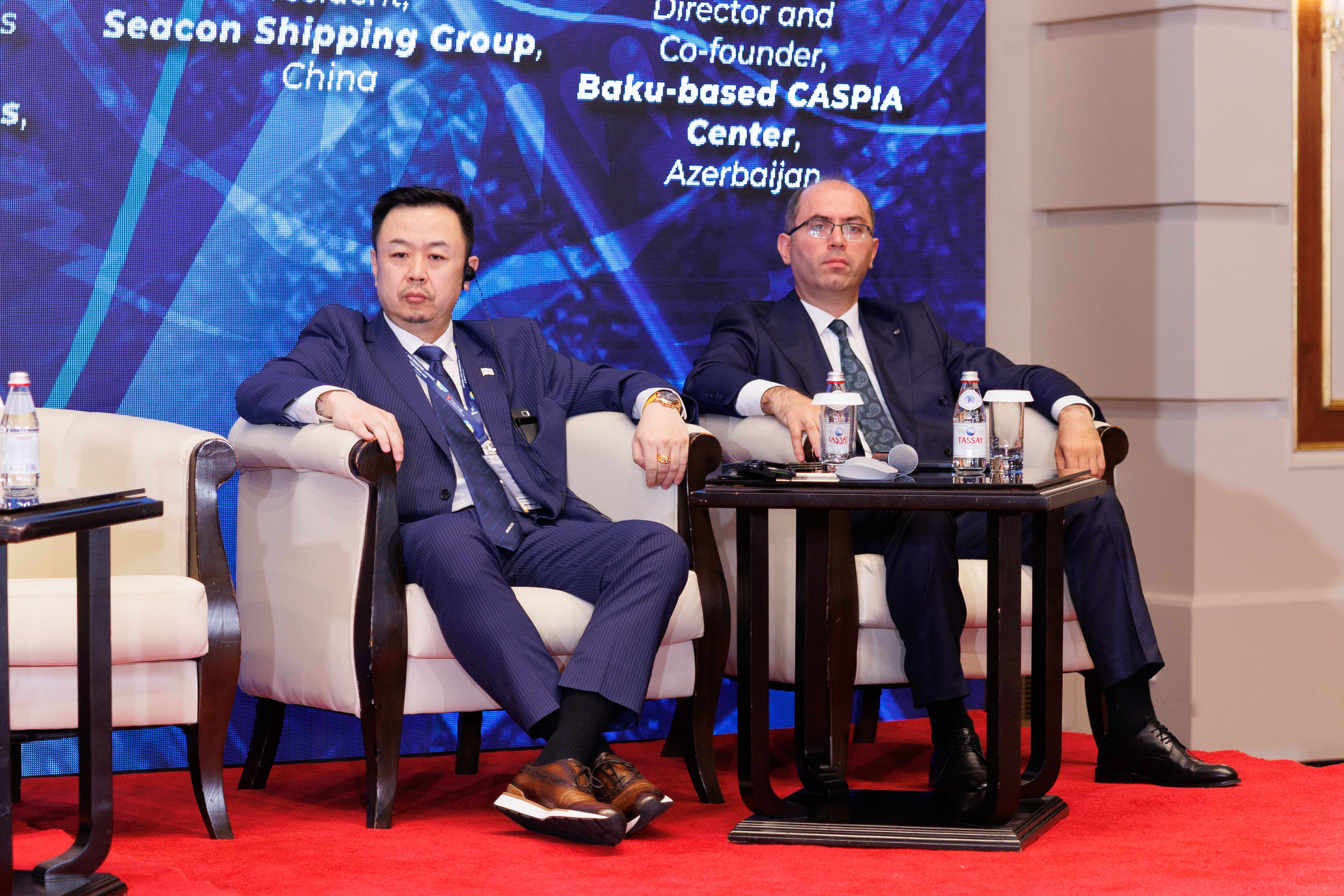
The Director of the CASPIA Analytical Center, Orkhan Yolchuyev, participated as a speaker at the "CATLIF26 – Central Asia Transport, Logistics & Investment Forum", an international platform that brought together government officials, representatives of international organizations, transport and logistics companies, investors, and leading experts to discuss the future of Eurasian connectivity and the development of international transport corridors.
During his presentation, Yolchuyev focused on the growing strategic importance of the *Trans-Caspian International Transport Route (Middle Corridor)*, emphasizing that the corridor has evolved beyond being merely an alternative route and is increasingly becoming one of the most significant logistical arteries connecting Asia and Europe.
"Azerbaijan is steadily becoming the logistics hub of the region, where key strategic transport nodes and some of the most advanced logistics infrastructure in Eurasia will be concentrated," Yolchuyev stated.
A central part of his presentation was dedicated to the "TRIPP (Trans-Caspian Transport Corridor Coordination Platform)" initiative, which he described as an essential mechanism for strengthening coordination among the countries participating in the Middle Corridor. According to Yolchuyev, effective institutional cooperation is now just as important as physical infrastructure in ensuring the corridor's long-term competitiveness.
He highlighted that Azerbaijan's continuous investments in transport infrastructure have significantly enhanced the country's role in regional connectivity. In particular, the ongoing expansion and modernization of the "Port of Alat", together with closer operational coordination with ports across the Caspian and Black Sea regions, will play a decisive role in increasing the efficiency, resilience, and interoperability of the Middle Corridor.
Yolchuyev also noted that the rapidly changing geopolitical landscape has substantially increased international interest in the Trans-Caspian route. Growing uncertainties affecting traditional transport corridors have accelerated the search for secure, diversified, and reliable trade routes linking Europe and Asia.
According to him, these developments are fundamentally reshaping the strategic value of the Middle Corridor.
"The Middle Corridor should no longer be viewed simply as an alternative route. It is emerging as one of the most important logistical arteries connecting regions, strengthening supply chain resilience and contributing to the transformation of Eurasian connectivity," he emphasized.
Concluding his remarks, Yolchuyev stressed that the future success of the Middle Corridor will depend not only on continued infrastructure investment but also on deeper regional cooperation, digitalization of transport processes, harmonization of customs procedures, and coordinated policy implementation among participating countries. In his view, these efforts will further consolidate Azerbaijan's position as a leading transport and logistics hub at the crossroads of Europe and Asia.